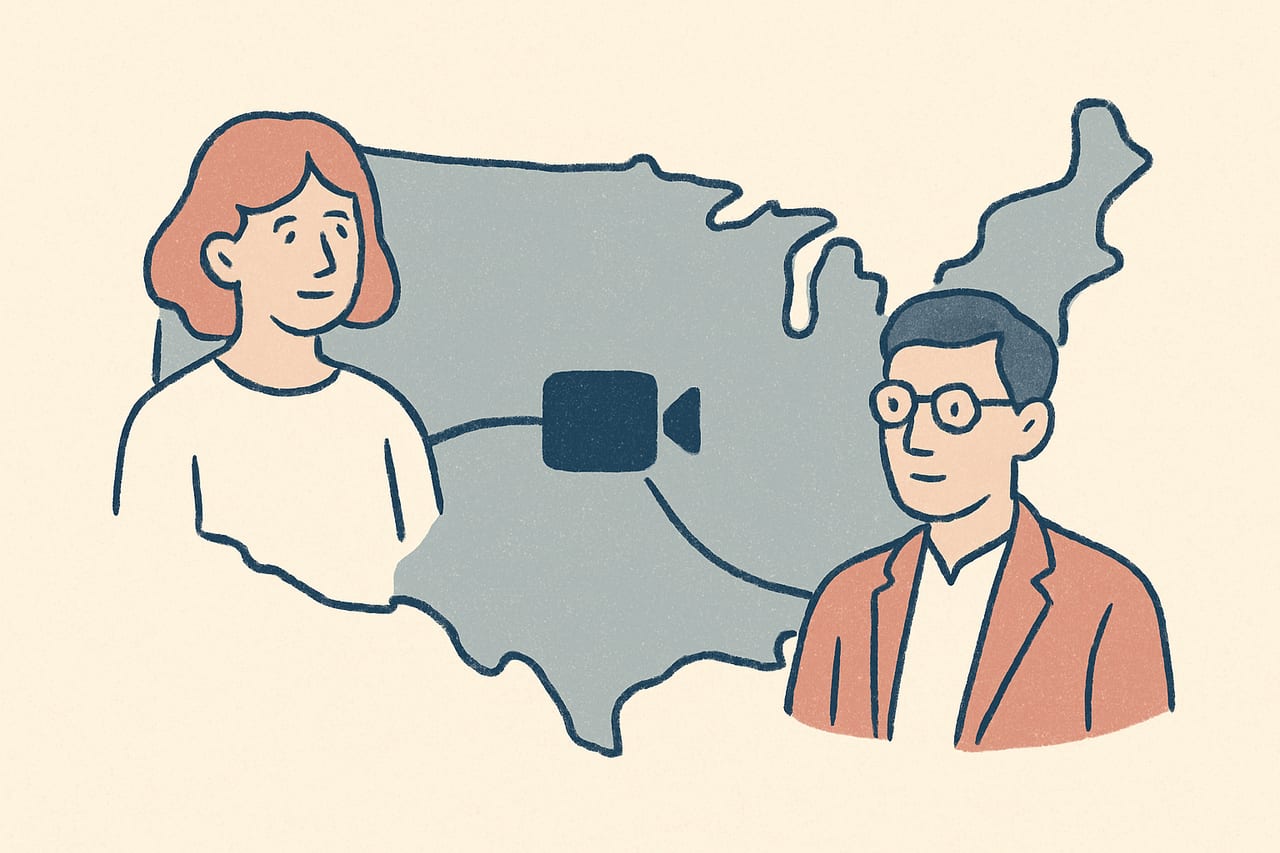
Running EMDR over video makes it easy to see a client who has moved, is traveling, or lives just across a state line — but your license doesn't automatically travel with the video call. This is a plain overview of the interstate compacts that let some US therapists practice telehealth across state lines, and where they fall short.
Why this is a licensure question, not a technology question
Practicing psychotherapy is regulated at the state level in the US, and the general rule is that you need to be licensed in the state where your client is physically located at the time of the session — not the state where you’re sitting. A remote EMDR session with a moving dot and a video call is technically simple; the licensing question underneath it is not. Getting this wrong isn’t just a technicality — practicing without the appropriate authority in a client’s state can put your license at risk.
This is a fast-moving area
Interstate compacts are actively rolling out state by state, and which states are operational changes throughout the year. Treat the specifics below as a snapshot, and verify current status with your compact's official site and your state board before relying on it.
PSYPACT: for licensed psychologists
The Psychological Interjurisdictional Compact (PSYPACT) is the most established option, letting licensed psychologists deliver telepsychology across participating states without obtaining a separate license in each one. It’s administered through the Association of State and Provincial Psychology Boards, and APA Services confirms a large majority of US jurisdictions have now passed PSYPACT legislation (APA Services, PSYPACT: interstate practice via telehealth). To use it, a psychologist applies for an E.Passport, which authorizes telepsychology practice into other PSYPACT states from their home license.
The important limitation: PSYPACT is specific to licensed psychologists. It does not extend to LCSWs, LMFTs, LPCs, or LMHCs — the professional groups that deliver a large share of EMDR therapy. If you’re not a licensed psychologist, PSYPACT doesn’t apply to you directly, even though it’s the compact most often mentioned in general telehealth-licensure articles.
The Counseling Compact: for LPCs and LMHCs
The Counseling Compact covers Licensed Professional Counselors, Licensed Mental Health Counselors, and Licensed Professional Clinical Counselors. It works similarly in concept — a counselor licensed in a compact member state can obtain a privilege to practice, including by telehealth, in another compact state that has finished implementation.
The key nuance is the gap between a state joining the compact on paper and the compact actually being operational there. As of mid-2026, only a handful of states — including Louisiana, Arkansas, Arizona, Georgia, Indiana, Minnesota, and Ohio — have completed the steps needed to actually issue privileges, even though far more states have passed the enabling legislation (Telehealth.org, cross-state licensure compact update). Being a “compact state” on a map is not the same as being able to practice there today — check operational status, not just membership.
The Social Work Compact: not yet usable
If you’re an LCSW, the Social Work Licensure Compact is the relevant one to watch, but it’s earlier in its rollout than the Counseling Compact. Reporting from mid-2026 describes the compact as activated — meaning enough states have joined to stand up its governing commission — but not yet operational for individual practitioners: no multistate license applications are being accepted, and the underlying data system is still being built (Telehealth.org, Social Work Licensure Compact update). If you’re an LCSW hoping to use this compact, there’s currently nothing to apply for yet, even in states that have joined.
What to do while a compact isn't operational in your state
Fall back on the traditional route: hold or obtain a license in the state where each telehealth client is physically located, or check whether that state offers a temporary telehealth registration for out-of-state clinicians, which some states provide outside the compact system entirely.
Practical steps before you take a cross-state client
- Confirm your discipline’s compact, if any, and whether it’s operational in both your state and your client’s state — not just whether both states have signed on.
- Ask new clients directly where they’ll physically be for sessions, and revisit this if they mention travel or a move — a client who relocates mid-treatment can put you outside your authority without either of you intending it.
- Document your licensure basis for cross-state clients the same way you’d document any other clinical decision.
- Combine this with your platform’s compliance setup. Licensure and data security are separate questions — see our HIPAA checklist for remote EMDR sessions for the latter.
- Factor licensure into how you evaluate software, not just features — our guide to choosing remote EMDR software covers the broader selection criteria.
Group practices and referral networks
If you run or work within a group practice, licensure across state lines is worth tracking at the practice level, not just per clinician. A practice that takes referrals nationally benefits from knowing, for each clinician, which states they’re licensed in and which compacts (if any) they can use — a simple internal spreadsheet is enough for most small practices. This also makes intake faster: when a prospective client’s state is a mismatch for every available clinician, it’s better to know that before scheduling a first session than to discover it partway through intake.
Where this fits with client screening
Licensure status is worth confirming during intake, alongside the other screening steps you’d normally run before starting remote EMDR — our guide to screening and informed consent covers what else belongs in that conversation.
Focus on the clinical work, not the technology
Once you've confirmed you're clear to practice with a client, CloudEMDR handles the bilateral stimulation side of the session — a moving dot and sound your client can follow over any video platform, with a distraction-free client link on Pro. The first three weeks are free.