Firefighters, paramedics, police officers, ER nurses, and physicians are exposed to trauma as a condition of the job, often repeatedly and over years. EMDR has been studied specifically in this population, and the results are encouraging without being conclusive. Here's what the evidence actually supports, and how shift-based schedules change the practical side of remote delivery.
What the evidence shows — and where it’s thin
A 2022 systematic review in the Journal of Traumatic Stress examined eight studies evaluating EMDR for work-related trauma specifically in first responders (Morris et al., 2022). The review’s conclusion is a useful, calibrated starting point: EMDR showed promise in reducing trauma symptoms tied to occupational exposure, but findings on using it as an early intervention — immediately after a critical incident, rather than for established symptoms — were inconclusive. The authors also flagged that all eight included studies were rated weak to medium quality on methodological grounds, and that the studies varied substantially in how EMDR was actually implemented (session count, timing relative to the incident, and protocol variant). Their stated conclusion was that “the conclusions that can be drawn from the literature are limited” — not that EMDR doesn’t work for this group, but that the current evidence doesn’t yet support strong claims about exactly when and how to use it.
That nuance matters in practice: treating an established, persistent symptom picture in a veteran firefighter is a different clinical question than offering EMDR as a critical-incident debrief immediately after a bad call, and the evidence speaks more confidently to the former than the latter.
Healthcare workers are a related but separate thread. Research conducted during the COVID-19 pandemic looked at EMDR as an early intervention specifically for healthcare workers experiencing pandemic-related psychological distress, and found preliminary support for it as a clinically beneficial, potentially scalable option in that acute context — though, as with the first-responder literature, this is still an early and limited evidence base rather than a settled one.
What’s different about this population’s schedule and presentation
A few things tend to be specific to first responders and healthcare workers that are worth building into how you set up remote care:
- Shift work makes consistent scheduling harder. Rotating shifts, on-call periods, and overnight work mean a client’s available session times may shift week to week. Remote delivery is genuinely useful here precisely because it removes commute time from an already constrained schedule — but it also means being flexible about session timing in a way that a fixed weekly in-person slot wouldn’t require.
- Cumulative, repeated exposure is common, not a single incident. Unlike a lot of civilian single-incident trauma, this population often brings years of layered exposure. Pacing and target selection — deciding which incidents to process first and how to sequence them — benefits from the same care you’d use with any complex trauma presentation.
- Occupational identity and return-to-duty concerns shape the work. Clients in this population are often weighing treatment against concerns about fitness-for-duty evaluations or how seeking help is perceived within their unit or department. That context is worth naming explicitly in your informed consent conversation; our guide to screening and informed consent for online EMDR is a reasonable template to adapt for occupational concerns specifically.
- Dissociation and hyperarousal can present differently in clients trained to stay functional under acute stress. If this is unfamiliar territory with a given client, pairing the session with solid grounding techniques for remote EMDR gives you something concrete to fall back on.
A note on your own exposure
Therapists who work consistently with first responders and healthcare workers are themselves exposed to a concentrated stream of occupational trauma material. If that's part of your caseload, our piece on vicarious trauma and self-care for EMDR therapists is worth reading on its own terms, not just as a footnote.
Working with department or hospital systems
Unlike many civilian clients, first responders and healthcare workers are often embedded in an organizational structure that has its own relationship to mental health care — peer support programs, employee assistance programs, chaplaincy services, or department-mandated evaluations after a critical incident. Remote delivery can make it easier for a client to access you without being seen walking into a therapist’s office near their workplace, which for some clients in this population is a genuine barrier to seeking care in the first place. It also means being clear, from the first session, about where your role starts and stops relative to any other support the client has access to through their employer, and getting written releases in place early if you’ll need to coordinate with an EAP or a department psychologist. That coordination is easier when your documentation already states clearly what you’re treating and why, which ties back to the broader habits covered in our guide to billing and documentation for remote EMDR sessions.
Running the remote session itself
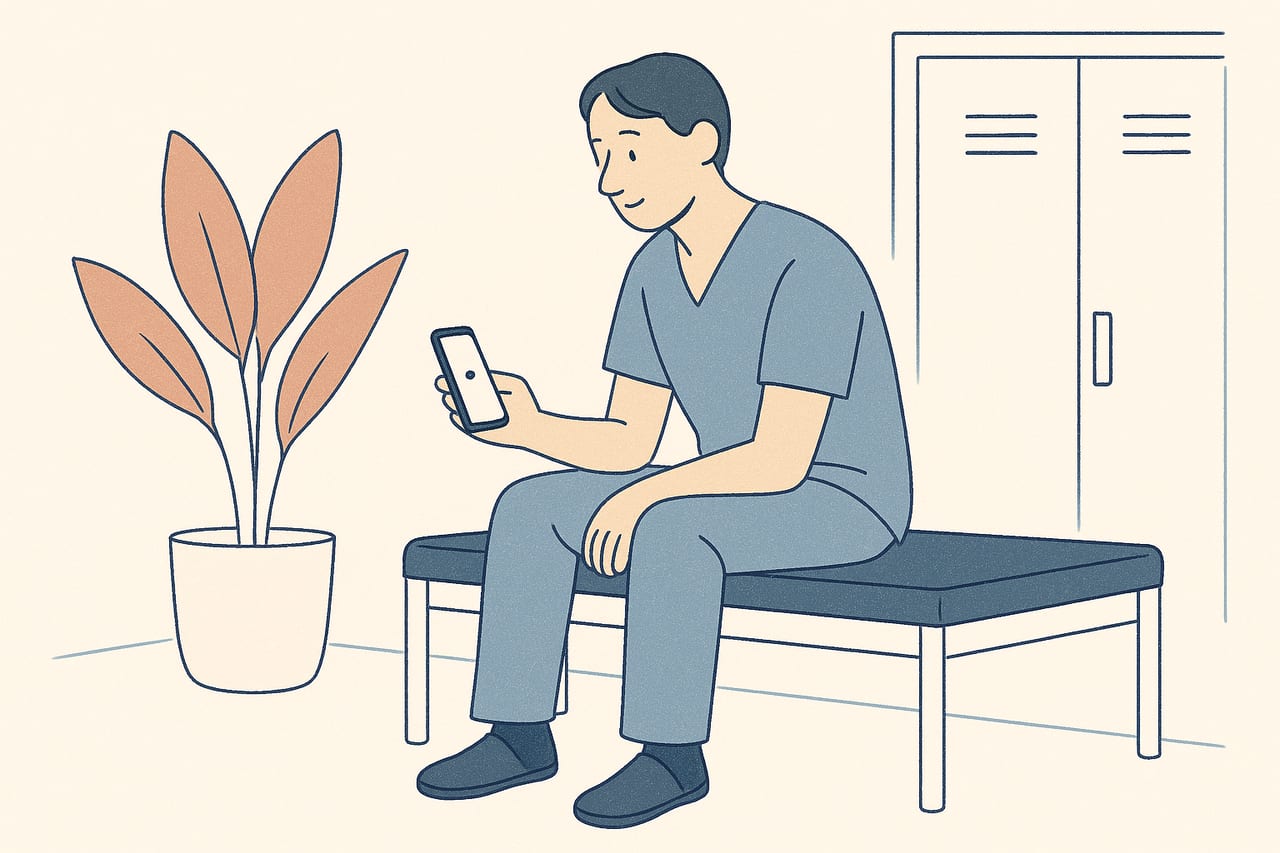
Nothing about this population changes the mechanics of the bilateral stimulation — the moving dot and bilateral sound work the same way regardless of who’s on the other end of the call. What tends to matter more is flexibility around scheduling (a client coming off a night shift may need a different pace than a standard daytime appointment) and making sure the session setup — private space, stable connection — holds up even when a client is joining from a station locker room or an on-call room rather than a home office.
Try the moving dot for free
CloudEMDR's moving dot, bilateral sound, and speed and size controls are free to try without an account. When you're ready to send clients a distraction-free link for Remote Sessions, Pro adds that along with more patterns, sounds, and backgrounds — the first three weeks are free.