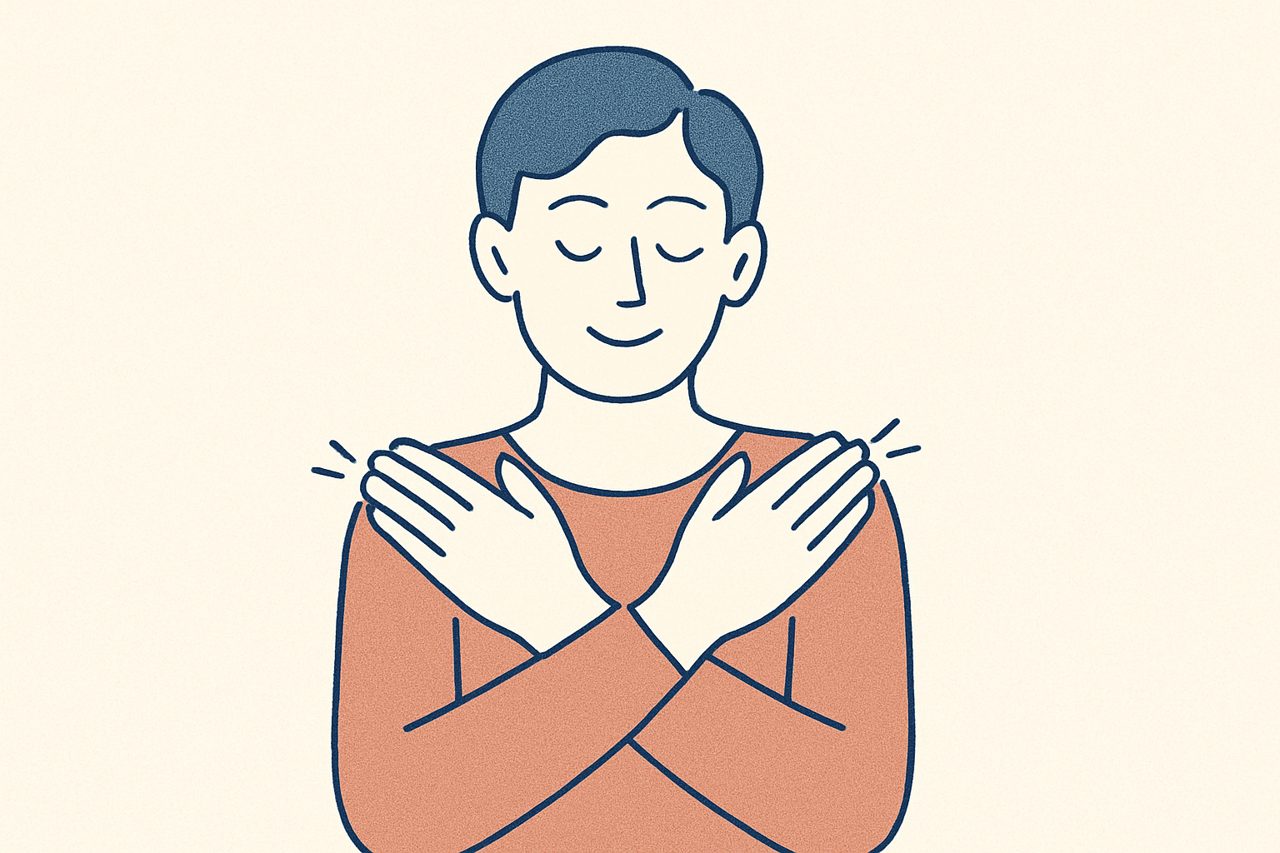
The moving dot and bilateral sound cover most of what you need for remote EMDR. But tactile techniques, where the client taps or is tapped in an alternating rhythm, are part of many therapists' toolkits too. When you are working over a video call, the butterfly hug and self-tapping give you options that do not depend on your client watching a screen.
Why tactile techniques matter online
Bilateral stimulation can be delivered through more than one channel. As we explain in our overview of what bilateral stimulation is, the common forms are visual (a moving dot), auditory (an alternating tone), and tactile (alternating taps or pulses).
In an in-person session, tactile stimulation is easy: you might use handheld buzzers or tap the client’s hands or knees. Over a video call, you cannot touch your client, so tactile work becomes something the client does for themselves under your guidance. That is where the butterfly hug and self-tapping come in.
Having a tactile option matters for a few practical reasons. Some clients find continuous visual tracking tiring. Others process more easily when they can close their eyes. And in moments where a client needs to feel more settled, a self-administered tactile technique can be gentler than a fast-moving dot.
The butterfly hug
The butterfly hug is a self-administered form of bilateral stimulation. The client crosses their arms over their chest, with each hand resting near the opposite shoulder or upper arm, and taps alternately, left then right, in a slow, steady rhythm. The crossed arms are said to resemble a butterfly’s wings, which is where the name comes from.
The technique is credited to Lucina Artigas, who developed it while working with survivors of Hurricane Pauline in Acapulco, Mexico, in 1998. It was created in a setting where many people needed support at once, and its self-administered design is part of why it spread: a client can do it without special equipment and without the therapist reaching them physically.
Why it suits remote work
Because the butterfly hug is self-administered, it translates cleanly to a video call. Your client can do it in their own space while you guide the pace and watch their response on screen. It needs no hardware, which removes one more thing that could go wrong with a remote setup.
Exactly how and when you use the butterfly hug, and how it fits your target sequence, is a matter for your EMDR training and protocol. Some therapists use it during resource or calming work; others use it within processing. The point here is simply that it remains available to you when you cannot be in the room.
Self-tapping
Self-tapping is the broader family the butterfly hug belongs to. Instead of crossing the arms, the client taps alternately on their knees, thighs, or the tops of their hands, left then right, at a pace you set. Some clients prefer this because it feels more neutral than the self-embrace of the butterfly hug, and it can be easier to keep visible on camera so you can watch the rhythm.
The mechanics are the same idea: an alternating, side-to-side tactile rhythm that the client can sustain on their own. As with any technique, you decide with the client which posture feels most comfortable and least distracting.
Combining tactile, visual, and audio
The useful thing about remote EMDR is that these channels are not either-or. The moving dot and bilateral sound run through CloudEMDR on your client’s screen, while a tactile technique is something the client does with their hands. That means you can pair them.
A client might track the dot while also doing the butterfly hug, or listen to bilateral sound with their eyes closed while self-tapping. Layering channels is also one way to add working-memory load, which we cover in our article on taxing working memory in EMDR. As always, more is not automatically better: add one channel at a time and watch how the client responds rather than stacking everything at once.
Here is a rough guide to when each option tends to fit.
- Moving dot: your default for most processing, when the client can comfortably watch the screen.
- Bilateral sound: useful with headphones, and when a client processes well with eyes closed or finds visual tracking tiring. See our piece on bilateral sound in EMDR.
- Butterfly hug: a self-administered tactile option, often chosen for calming and resourcing, and handy when you want to move away from the screen.
- Self-tapping: a more neutral tactile alternative to the butterfly hug, easy to keep visible on camera.
Guide the pace, then let the client carry it
With any self-administered technique, your job over video is to set and steady the rhythm, then watch. Because you cannot feel the taps, rely on what you can see and on the client's report. If the pace drifts or the client tenses up, a calm verbal cue to slow down is usually enough.
Setting up tactile work over video
Tactile techniques ask a little of your video setup. You want to be able to see the client clearly enough to read their pace and their face, which comes down to framing and lighting. Our guide on preparing your client covers how to help them set up their space and camera before you begin.
It also helps to demonstrate. Rather than only describing the butterfly hug, show it on your own camera first, then invite the client to mirror you. A quick shared practice run removes the guesswork, especially for a client doing it for the first time.
Whichever technique you reach for, the underlying goal is the same one that guides the rest of your EMDR work: a steady, alternating rhythm that supports processing while the client stays within their window of tolerance. CloudEMDR handles the visual and audio channels; the butterfly hug and self-tapping fill in the tactile one when you are apart.
Run flexible remote EMDR sessions
CloudEMDR Pro pairs the moving dot and five bilateral sounds with distraction-free Remote Sessions, so you can combine channels while your client sees only the dot. The first three weeks are free, and you can cancel anytime.